


Table of Contents
- Tight, overworked muscles and muscle knots
- How Massage Affects Posture-Related Muscle Tension
- Temporary Relief Versus Lasting Postural Change
- Massage for Rounded Shoulders: What to Expect
- Exercises and Stretching That Support Posture Recovery
- How Massage Affects Posture-Related Muscle Tension
- When Posture Pain Needs a Medical Assessment
- Booking a Consultation to Build Your Own Plan
- Frequently Asked Questions
What Posture Pain Actually Involves
Most people who search “does massage fix posture pain” are tired of feeling tight every day. The short answer is that massage can ease the pain, but it rarely fixes the posture by itself. The honest answer depends on what is causing the ache. (Source: Government of Canada’s physical activity guidelines)
Posture pain usually comes from a mix of muscles that work too hard and muscles that switch off. Long hours at a screen can pull the chest tight while the upper back gets weak. Over time, this pattern creates a sore neck, tight shoulders, and a headache that shows up by mid-afternoon.
Tight, overworked muscles and muscle knots
Muscles that stay in one position for hours start to hold tension. The upper trapezius and the muscles along the neck are common culprits for office workers.
Muscle knots, also called trigger points, are tender spots that feel tight and sometimes send pain to nearby areas. They form when a muscle stays contracted too long, not from one bad moment.
- Tight muscles often feel hard and sore to the touch
- Knots can cause pain that spreads toward the shoulder blade or head
- Movement often feels stiff until the muscle warms up
Rounded shoulders and forward-head posture
Sitting with the head pushed forward shifts weight onto the neck and upper back. This is often called forward-head posture. Rounded shoulders usually come with it, as the chest muscles shorten and the upper back stretches.
These positions are not a sign of damage on their own. They do explain why the same areas keep hurting week after week.
How Massage Affects Posture-Related Muscle Tension
Massage works on the soft tissue around these muscles. It can reduce tension, improve comfort, and help a tight area feel more relaxed. Registered massage therapists typically focus on this soft-tissue layer, because a muscle that feels less guarded is easier to move.
Massage does not change the bones or the way the spine is built. It changes how the muscles around them feel in the moment.
Trigger points, myofascial release and range of motion
Trigger point work applies steady pressure to a knot until it softens. Myofascial release uses slow, sustained pressure to ease the connective tissue that wraps around muscles. Both aim to reduce tension and make movement feel less restricted.
People often notice their neck turns more easily after a massage. That gain in range of motion can fade if the daily habits that caused the tightness stay the same.
Temporary Relief Versus Lasting Postural Change
This is the part most people want to hear clearly. Massage usually gives short-term relief. The muscles feel looser, and pain may drop for a few hours or a few days. Lasting postural change takes a different approach, and the difference between the two is worth understanding before you book a series of sessions.

Why the relief fades
Massage works on the soft tissue layer. It can reduce guarding, improve local blood flow, and make a tight area feel more relaxed. What it does not do is change the load that created the tightness in the first place. If you return to the same chair, the same screen height, and the same eight hours of stillness, the upper trapezius and neck extensors will gradually tighten again.
That does not make the session pointless. It means the session is one input, not the whole plan.
What the evidence does and does not establish
Massage may improve comfortable range of motion, but there is no strong evidence that massage alone permanently corrects forward-head posture or rounded shoulders. Treat claims of “posture correction” with caution, including from therapists.
- Supported by reasonable evidence: short-term pain relief, reduced muscle tension, improved comfort and mobility
- Not well supported: permanent postural correction from massage alone
- Plausible but unproven: massage making exercise and habit change easier to sustain
How to tell whether you are making lasting progress
Appearance is a poor measure. A single posture snapshot varies with fatigue, time of day, and how you are standing. Better indicators are functional and trackable over weeks:
- Pain: average level across a week, not just on the day of your session
- Function: can you work a full day without the mid-afternoon headache?
- Comfortable range of motion: does your neck turn further before it feels tight?
- Endurance: can you hold a supported sitting or standing position longer than you could a month ago?
- Recovery speed: when tension returns, does it ease faster with your home routine?
Track two or three of these in a simple note on your phone. If nothing changes after four to six weeks of combined massage, movement, and workstation adjustment, that is useful information, it may mean the cause is something massage cannot address, and a reassessment is warranted.
Watch out: judging progress by how you feel the day after a session will almost always look like success, because that is the peak of temporary relief. Judge by the weekly trend instead.
- Temporary relief: less pain and stiffness after a session
- Lasting change: new habits, strength, and movement that hold over time
- Best results: massage combined with movement and posture awareness
Realistic expectations matter. A single session will not undo years of desk habits, and a course of sessions without habit change tends to produce a repeating cycle of relief and return.
The table below sets out what massage can and cannot be expected to do for posture pain, based on the points covered in this section.
| Outcome | Evidence level | Note |
|---|---|---|
| Short-term pain relief | Reasonable evidence | Usually lasts hours to days |
| Reduced muscle tension | Reasonable evidence | Works on soft tissue |
| Improved comfort and mobility | Reasonable evidence | Neck may turn more easily |
| Permanent postural correction | Not well supported | Massage alone does not fix it |
| Making habit change easier | Plausible but unproven | Pairs with movement and awareness |
Massage for Rounded Shoulders: What to Expect
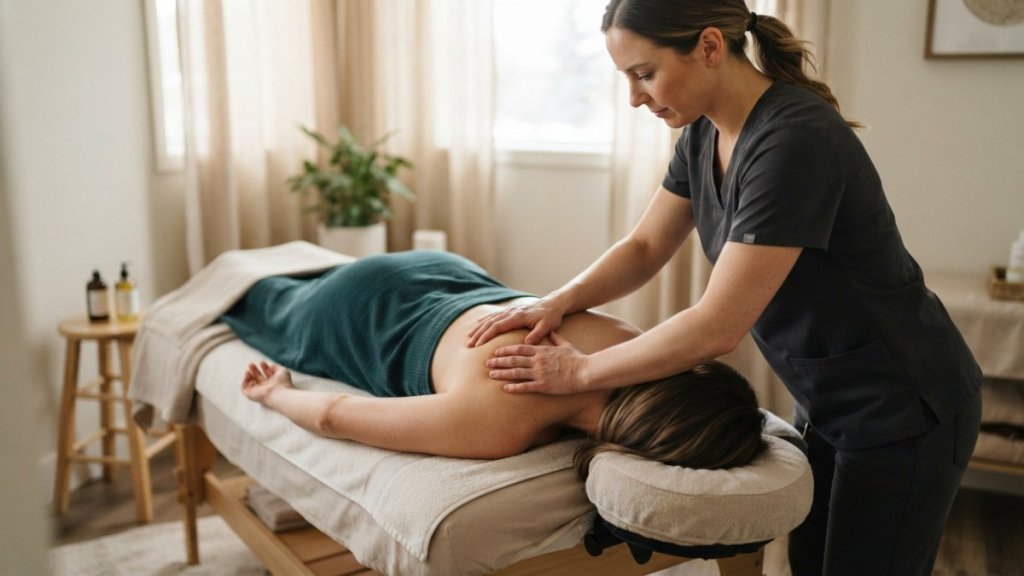
A session focused on rounded shoulders usually works on the chest, front shoulder, and upper back. The therapist will ask about your pain, your work setup, and any past injuries before starting.
Pressure should feel firm but never sharp. You may feel sore for a day afterward, which is normal. If pain gets worse or lasts longer than a couple of days, let your therapist know.
Our team at Lakeside Spa can tailor a session to your shoulders and neck. Therapeutic Massage is a good starting point for posture-related tension. For a deeper approach, Deep Tissue Massage for Shoulder Pain: What You Need to Know explains what that type of work involves.
Exercises and Stretching That Support Posture Recovery
Movement helps keep gains from massage. A short daily routine can make a real difference, especially for people who sit most of the day.
Try a simple neck stretch: gently tilt your ear toward your shoulder, hold for 20 seconds, then switch sides. Chin tucks, where you draw the head straight back, can also help reset forward-head posture.
For a complete routine, read massage for desk neck tension, a step-by-step routine. It walks through each move in order.
Posture exercises for desk workers
- Stand up and move every 30 to 45 minutes
- Do chest stretches in a doorway to open tight pecs
- Strengthen the upper back with rows or band pulls
- Adjust your screen so the top sits at eye level
Small, regular habits usually beat one long workout.
How Massage Affects Posture-Related Muscle Tension
Earlier, we looked at how massage eases muscle tension. Here is how that fits into a bigger picture. Tension that eases during a session may return if the load on those muscles stays high. This is why many people feel better for a while and then notice the pain creeping back.
Lower Back Pain Relief in South Calgary: Discover the Power of Therapeutic Massage explores how reducing muscle tension and improving blood flow can help with pain that comes from long hours of sitting.
When Posture Pain Needs a Medical Assessment
Massage is commonly used for tight muscles and everyday posture aches, but it is not a substitute for assessment when symptoms are unusual. Some symptoms need a professional assessment before any treatment, though, and knowing which is which protects you from delaying care for something massage cannot fix.
Symptoms that warrant a doctor or physiotherapist first
Seek medical care before booking massage if you notice any of the following:
- Numbness, tingling, or weakness in an arm or hand, this can point to nerve involvement in the neck, which massage may aggravate if the cause is not assessed
- Pain that wakes you at night or does not ease with position change, persistent night pain is a reason to rule out causes beyond muscle tension
- Pain that began after a fall, collision, or other injury, whiplash-type injuries and joint problems need assessment before soft-tissue work
- Fever, unexplained weight loss, or feeling generally unwell alongside the pain, these are constitutional symptoms that change the picture entirely
- Severe headache with neck stiffness, or any new neurological symptom, seek urgent care rather than a massage appointment
- Pain that has worsened steadily over several weeks despite rest and home care
What a physiotherapist or physician can check that massage cannot
A massage therapist works on soft tissue. A physician or physiotherapist can assess nerve conduction, joint stability, and movement patterns, and can order imaging if needed. If your pain travels down the arm with tingling, or if one shoulder sits noticeably differently after an injury, that is a structural or neurological question, not a muscle-tension question. Getting it checked first does not mean you cannot have massage later, it means the massage is informed by a proper diagnosis.
How to raise it with your therapist
A registered massage therapist should ask about your history before starting, but you can help by being specific. Mention any numbness, any past injury to the area, any medication that affects bleeding or sensation, and whether the pain has changed character recently. A therapist will typically refer you out when something falls outside their scope.
Massage therapy is not a substitute for a medical diagnosis. If you are unsure whether your ache is the ordinary kind that responds to soft-tissue work, a short consultation with a physiotherapist or your family doctor is a reasonable first step before committing to a series of sessions.
Booking a Consultation to Build Your Own Plan
Every body and work setup is different. A short consultation helps you and your therapist decide what to focus on, how often to book, and which habits to change first.
Watch out: if you wait until pain is severe to seek help, recovery usually takes longer, so early attention tends to work better.
At Lakeside Spa, our team can discuss your goals and help you decide on a suitable plan. To get started, you can book online.
Frequently Asked Questions
Can massage fix poor posture?
Massage can ease the muscle tension and soreness that often come with poor posture, and many people feel looser afterward. It does not usually change the underlying postural habits on its own. Lasting change tends to come from combining massage with regular movement, strengthening and changes to how you sit and work. Think of massage as one part of a plan, not a standalone fix for posture.
Does massage help with pain caused by poor posture?
Yes, massage often reduces pain linked to posture, particularly tension in the neck, shoulders and upper back. Relief is commonly temporary, lasting hours or days depending on the person and the cause. If pain persists, worsens or spreads, or comes with numbness or weakness, book an assessment with a qualified health professional rather than relying on massage alone.
What type of massage is best for posture-related pain?
There is no single best type for everyone. Relaxation and therapeutic massage focus on general muscle tension, while deep tissue work targets deeper, more persistent tightness. Your registered massage therapist can talk through your goals and history with you and recommend an approach suited to your body and comfort level. Communicate pressure preferences during the session.
When should you see a health professional for posture-related pain?
See a health professional if your pain is severe, lasts more than a few weeks, keeps returning, or is accompanied by numbness, tingling, weakness or headaches. These signs can point to issues that need individual assessment. A physiotherapist or your family doctor can help determine whether massage is appropriate alongside other care. This article offers general information only and is not individual medical advice.

