


Table of Contents
- Is Prenatal Massage Safe During Pregnancy? What the General Guidance Says
- Prenatal Massage in the First Trimester: When to Wait and What to Ask
- Safe Prenatal Massage Positions and Pregnancy Support
- Massage Areas to Avoid During Pregnancy and Pressure Guidelines
- Warning Signs During or After a Session and When to Seek Medical Clearance
- How Often to Get a Prenatal Massage and Planning Sessions Safely
- Booking Your First Prenatal Session With a Registered Massage Therapist
- Frequently Asked Questions
Is Prenatal Massage Safe During Pregnancy? What the General Guidance Says
Last Updated: November 15, 2026
Is prenatal massage safe during pregnancy? For most healthy pregnancies, a session with a trained therapist is generally considered low risk, but the details matter. Registered massage therapists can adjust pressure, positioning and technique for each stage of pregnancy.
Prenatal massage is a form of massage therapy adapted for expectant mothers. It uses support pillows, side-lying positions and gentler pressure than a standard session. Many people turn to it for back pain, hip discomfort and general stress relief.
Here is the general picture. Training is widely regarded as one of the most important factors. A therapist who understands pregnancy anatomy can avoid the areas that need care and adjust for changes in circulation and balance.
Before booking, check with your doctor or midwife. This is especially important if you have a history of pregnancy complications, high blood pressure, blood clots or a high-risk pregnancy. Health Canada and provincial health authorities provide general pregnancy health information, and you can Government of Canada pregnancy and healthy eating guidance for trusted background reading.
A common mistake is assuming all massage therapists are trained in prenatal care. Ask about specific training before your first visit.
Prenatal Massage in the First Trimester: When to Wait and What to Ask
First-trimester questions are the most common ones prenatal therapists field, and they deserve a more precise answer than “wait and see.” The evidence base on massage in early pregnancy is limited, so guidance generally rests on physiological reasoning, clinical experience and precaution rather than proof of harm or proof of safety.
What the reasoning actually says. Miscarriage in the first trimester is common and most often caused by chromosomal factors unrelated to anything the mother does.
Where the caution comes from. The conservative habit of waiting until the second trimester is largely about uncertainty and liability rather than a known hazard. Early pregnancy symptoms, nausea, fatigue, breast tenderness, dizziness, make sessions less comfortable, and a therapist working before the pregnancy is well established has less information to work with. Some clinics also express concern about liability.
A trimester-by-trimester way to think about it:
- Weeks 1-12 (first trimester): Gentle, shorter sessions are reasonable for most people with an uncomplicated pregnancy who feel well. Get clearance first if you have any risk factors (see the checklist in the medical-clearance section). Avoid deep abdominal work, strong pressure on the lower back and any attempt at “induction” points.
- Weeks 13-27 (second trimester): Usually the most comfortable window. Nausea typically settles, the belly is manageable with side-lying support, and most therapists are happy to work at moderate pressure.
- Weeks 28 to birth: Focus shifts to positioning, hip and low-back relief, and shorter sessions. Avoid flat-on-back positioning and watch for swelling or calf symptoms.
Questions to ask before a first-trimester session:
- Have you had bleeding, spotting or cramping in this pregnancy?
- Have you had a previous miscarriage or preterm birth?
- Has your doctor or midwife cleared you for massage, and did they set any limits?
- Are you taking medications or managing a condition that affects circulation or blood pressure?
- Is this a single pregnancy or multiples?
Watch out: Do not book a deep-tissue or full-body session in the first trimester just because discomfort is strong. Strong pressure, long sessions and aggressive stretching are the parts to defer, and if your provider has advised waiting, that advice overrides any general reassurance here.
One practical note: if you are booking before 12 weeks, tell the therapist your dates at the time of booking, not on the table.
Safe Prenatal Massage Positions and Pregnancy Support
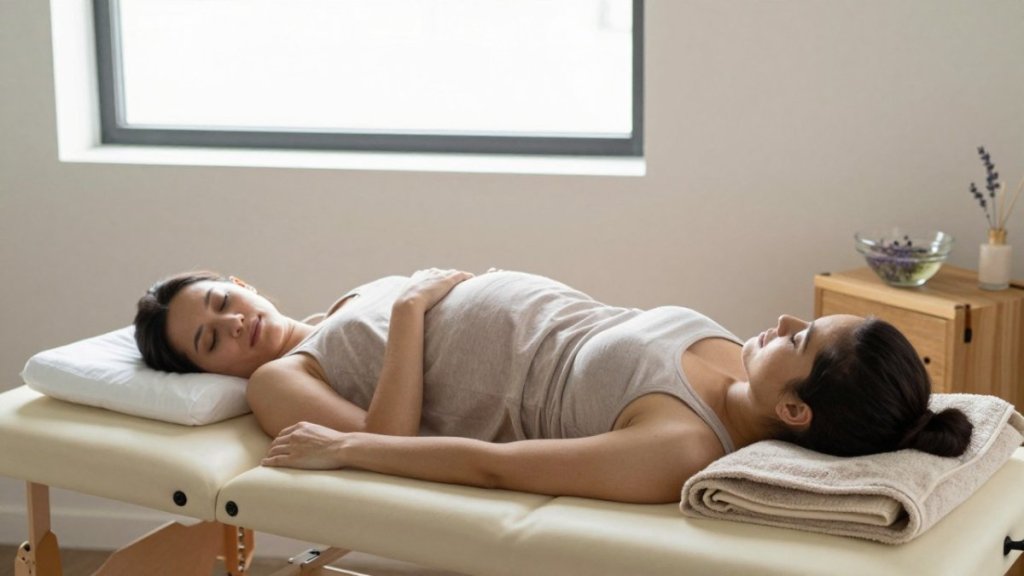
Positioning is one of the main differences between prenatal and standard massage. You can see how a prenatal massage session is structured on our prenatal massage service page. Lying flat on the back is generally avoided after the first trimester, because the weight of the uterus can press on the large vein that returns blood to the heart. This can reduce circulation and cause dizziness.

Common safe positions include:
- Side-lying: The most common position, supported by pillows under the belly, back and between the knees.
- Seated: Useful for neck and shoulder work, with the chest resting on a support.
- Hands-and-knees variations: Used only when the client is comfortable and the therapist has the right equipment.
Bolsters and wedge pillows are commonly used to help keep the body aligned. Ask about the setup before your session, and say if any position feels uncomfortable at any point.
Massage Areas to Avoid During Pregnancy and Pressure Guidelines
Some areas need extra care or should be avoided altogether. The abdomen should not receive deep pressure. The inner and outer ankles and calves need careful handling, because deep work there can be a concern for people at risk of blood clots.
Pressure should stay light to moderate for most of the session. Many people find that they can relax more with gentle, steady work than with strong pressure.
- Avoid deep abdominal pressure at all stages
- Be cautious with deep leg massage, especially if there is swelling or pain in one calf
- Avoid pressure points linked to labour induction in the first and second trimesters
- Tell your therapist right away if any pressure causes pain
Reflexology and some essential oils are also often avoided in early pregnancy. Ask your therapist what they use and why before your session.
Warning Signs During or After a Session and When to Seek Medical Clearance
Safety guidance is only useful if you can act on it, so this section covers three things: who should get clearance before booking, what to watch for during and after a session, and what “clearance” should actually look like.
Get medical clearance before booking if any of these apply
This is not a complete list, and your provider’s judgment comes first, but these are the situations where a responsible therapist will want a note or a conversation before working with you:
- High-risk pregnancy as classified by your provider, including multiples, placenta previa, cervical insufficiency or a history of preterm birth
- Current or recent vaginal bleeding, spotting or fluid leakage
- Pre-eclampsia, gestational hypertension or a history of either
- Blood clot history, current anticoagulant use, or known clotting disorders
- Severe varicose veins, or swelling, redness, heat or pain in one calf (possible deep vein thrombosis, this needs medical assessment, not massage)
- Fever, active infection or a contagious illness
- Uncontrolled diabetes, significant heart conditions or recent surgery
- Hyperemesis gravidarum or severe nausea that makes lying down difficult
- Any condition your provider has already told you to restrict activity for
If you are unsure whether you fall into one of these groups, call your provider’s office rather than deciding on your own. A short phone call is cheaper than a complication.
What “clearance” should look like
A vague “massage is probably fine” from a friend is not clearance. In practice, clearance means your doctor or midwife has reviewed your specific situation and either approved massage or set limits, for example, side-lying only, no abdominal work, sessions under 45 minutes, or avoiding a particular area. Ask for those limits in writing if you can, and pass them to your therapist at booking. A well-run clinic will document them.
Stop the session and contact your provider if you notice
- Vaginal bleeding or fluid leaking
- Sudden swelling in one leg, or a calf that is hot, red or painful
- Chest pain, trouble breathing or a racing heartbeat
- Severe headache, dizziness, blurred vision or seeing spots
- Reduced fetal movement after about 28 weeks
- Contractions or cramping that does not ease with rest and water
- A feeling that something is wrong, intuition is a legitimate reason to stop
Seek urgent care rather than waiting
Some symptoms should not wait for a next-day call. Go to an emergency department or call emergency services for chest pain, difficulty breathing, signs of a blood clot in the leg, heavy bleeding, severe abdominal pain, or a severe headache with vision changes. These can be signs of serious conditions, including pre-eclampsia or thromboembolism, that have nothing to do with the massage but need immediate assessment.
After the session
Mild soreness or tiredness for a day is normal. What is not normal: pain that worsens rather than settles, new swelling, a headache that will not lift, or any of the red flags above. When in doubt, call your provider and mention that you had a massage, it is relevant context, not an admission of anything.
Watch out: Do not treat a massage session as a substitute for a medical appointment. If a symptom concerns you, the therapist cannot diagnose it, and “it’s probably fine” from anyone other than your provider is not reassurance.
Clearance and warning signs vary by situation, so the table below lists the key points from this section for quick reference.
| Stage | What to check | Action |
|---|---|---|
| Before booking | High-risk pregnancy, bleeding, clotting history | Get medical clearance first |
| Before booking | Pre-eclampsia or gestational hypertension | Get medical clearance first |
| During session | Vaginal bleeding or fluid leaking | Stop and contact your provider |
| During session | Sudden swelling or a hot, painful calf | Stop and contact your provider |
| During session | Severe headache, dizziness or blurred vision | Stop and contact your provider |
| Emergency | Chest pain or trouble breathing | Seek urgent care |
| Emergency | Heavy bleeding or severe abdominal pain | Seek urgent care |
How Often to Get a Prenatal Massage and Planning Sessions Safely
There is no single rule for how often to book. Frequency varies with comfort, needs and budget. Others book once in a while when they need relief.
Plan your sessions with these points in mind:
- Book a session when you feel tension, not just on a fixed schedule
- Leave time between sessions to notice how your body responds
- Check your schedule against medical appointments
- Consider a shorter session if you are tired or unwell
If you want a relaxing visit with a few other treatments, you can also browse our book a massage or spa treatment options for your next appointment.
Booking Your First Prenatal Session With a Registered Massage Therapist
When you are ready to book, look for a registered massage therapist with prenatal training. Our team includes registered massage therapists (RMTs), and you can book an experienced prenatal massage therapist to meet with a practitioner who works with expectant mothers.
Before your first visit, it helps to understand the basics of registration and training. You can read our guide on why registered massage therapy matters to learn what credentials to look for.
Bring a list of questions and your provider’s guidance. Tell your therapist about your trimester, any health conditions and any areas of discomfort. A good therapist will adjust the session to fit you.
Ready to take the next step? Book with Lakeside Spa today and let our team help you find the right session for your pregnancy. Registered massage therapists can help with comfort and relief from back, hip and neck tension.
BUTTON: Book Your Prenatal Massage
CARD_TITLE: Is prenatal massage right for you?
CARD_TEXT: Lakeside Spa’s registered massage therapists offer prenatal massage with direct billing.
Frequently Asked Questions
Is prenatal massage safe during pregnancy?
For most uncomplicated pregnancies, prenatal massage is generally considered safe when it is performed by a therapist with prenatal training. Safety depends on the stage of pregnancy, the pressure used, the positioning and any pre-existing medical conditions. Anyone with a high-risk pregnancy, a history of miscarriage, preeclampsia, blood clots or unexplained bleeding should get medical clearance from their healthcare provider before booking. Tell your therapist about your pregnancy at the start of every session.
Can you get a prenatal massage in the first trimester?
Many providers recommend waiting until after the first trimester, when miscarriage risk is highest, unless your healthcare provider has approved an earlier session. Once you have clearance, gentle techniques focused on the back, shoulders and legs are usually the first sessions people book. Let your therapist know how far along you are and whether you have any spotting, cramping or nausea before the session begins.
What positions are safe for a prenatal massage?
Side-lying positions supported by pillows between the knees, under the belly and behind the back are the most common for prenatal massage. Lying on the back is usually avoided after the first trimester because the weight of the uterus can compress the major blood vessels. Face-down positions are generally not used in pregnancy. Ask your therapist to adjust cushions as needed so you stay comfortable throughout the session.
How often can you get a prenatal massage?
Frequency depends on your comfort, your healthcare provider’s guidance and your budget. Frequency varies with comfort, needs and budget. For current pricing, check the Lakeside Spa website or request a quote.

